
The Case for Citizen-Centric Design in Public Services
Why reimagining service delivery from the citizen’s perspective is essential for inclusion, trust, and impact.

As governments worldwide invest in digitization and reform, a fundamental question lies at the heart of public service delivery: Are we designing for what’s easy for the system — or for what’s right for the citizen?
Too often, public services are structured around the logic of administrative departments, legacy processes, and internal efficiency. But for a citizen navigating life — from birth to death — what matters is something very different: Can I access the service I need easily, affordably, and with dignity?
This is where citizen-centric design comes in — a shift in mindset, strategy, and execution that puts people, not institutions, at the center of public systems.
Why the System-Citizen Gap Exists
There is an inherent dichotomy between what works best for government systems and what works best for citizens:
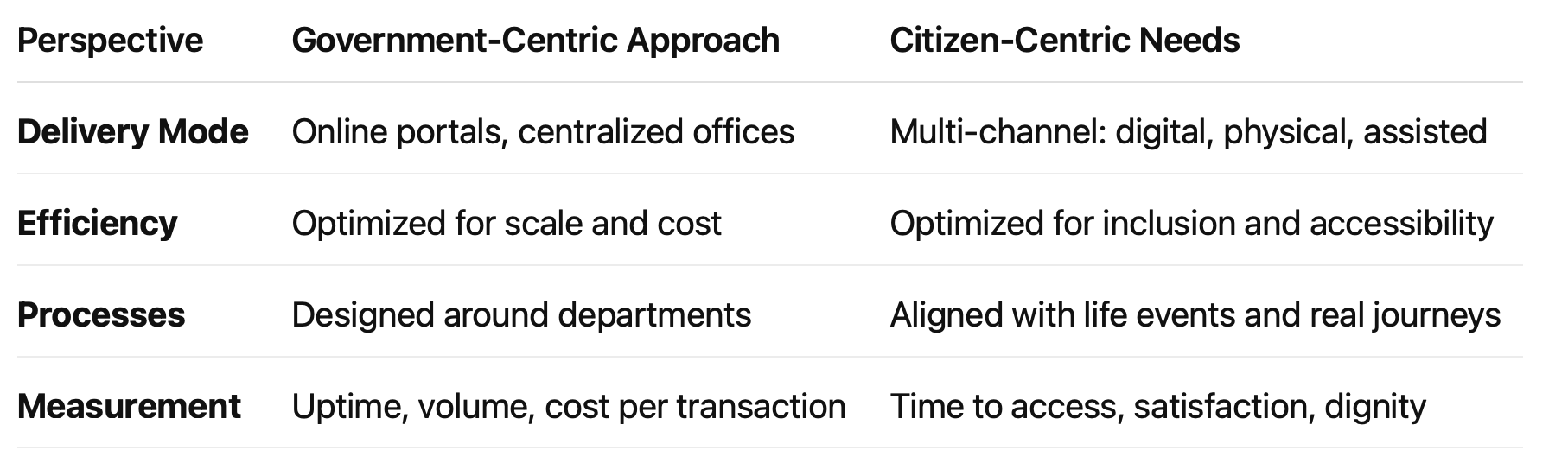
As a result, services may appear well-designed on paper, but exclude those most in need — the elderly, rural residents, informal workers, people with disabilities, or those lacking digital access.
What Citizens Actually Experience
Consider a parent trying to enroll a child in school, or a pensioner applying for benefits:
Long travel to government offices
Standing in queues, submitting repeated documentation
Paying agents or middlemen to “get it done”
Returning multiple times to track status or correct errors
For many, the cost of access — in time, money, effort, and lost dignity — is greater than the benefit itself.
Reimagining Public Services Around the Citizen
Citizen-centric design requires us to invert the lens — from system-first to people-first. This means:
1. Start with the Life Journey, Not the Department
Map services across key life stages: birth, schooling, employment, health, family, aging, and end-of-life. Citizens don’t think in terms of ministries — they think in terms of needs.
2. Reduce the Cost of Access
Design for low-income, low-literacy, and marginalized users. Consider the total burden on the citizen: travel, lost wages, paperwork, and digital barriers.
3. Design for the Excluded First
If a service works for the hardest-to-reach — it will likely work for everyone. Inclusion improves universality.
4. Ensure Optionality Through Multi-Channel Access
Citizens should have the freedom to choose how they interact with public services — whether through digital platforms, in-person service centers, community outreach, or with help from trusted intermediaries.
Optionality is not a luxury — it’s essential for inclusion. Different people face different constraints: some may lack digital access, others may be uncomfortable with bureaucratic offices. Some may need assistance navigating complex processes.
One-size-fits-all rarely fits anyone. Optionality ensures that services adapt to the citizen — not the other way around.
5. Measure What Matters
Don’t stop at service uptime or digital completion rates. Ask: Was the service accessible? Was it timely? Was it fair? Was the citizen satisfied?
From Principles to Practice
Citizen-centric public services are not just a design choice — they are a governance imperative. They build trust, increase uptake, reduce corruption, and ensure that public money actually reaches those it was intended to serve.
In a truly citizen-centered system, the burden shifts from the citizen navigating the state — to the state organizing around the citizen.
A Call to Action
Governments, technologists, and reformers must come together to:
Reimagine service delivery from the citizen’s point of view
Build inclusive systems that leave no one behind
Continuously listen to user feedback and evolve
And above all, remember that behind every form, every certificate, every number — is a person, with needs, rights, and dignity.